Caliche and turf drainage in Henderson
The layer under your yard that decides what your installation costs and whether it lasts.
The layer under your yard that decides what your installation costs and whether it lasts.
Turf backing drains at over 30 inches per hour. That statistic gets quoted constantly and means very little on its own, because water leaving the turf still has to go somewhere. In the Las Vegas Valley, what it frequently hits is caliche.
Caliche is a hardened layer of calcium carbonate that has cemented soil particles together over thousands of years. It is common throughout the Southwest and widespread across the valley. It ranges from a crumbly few inches to slabs of genuine rock hardness that require jackhammers or heavy equipment.
Two properties matter for turf. It is hard, which affects excavation. And it is effectively impermeable, which affects drainage.
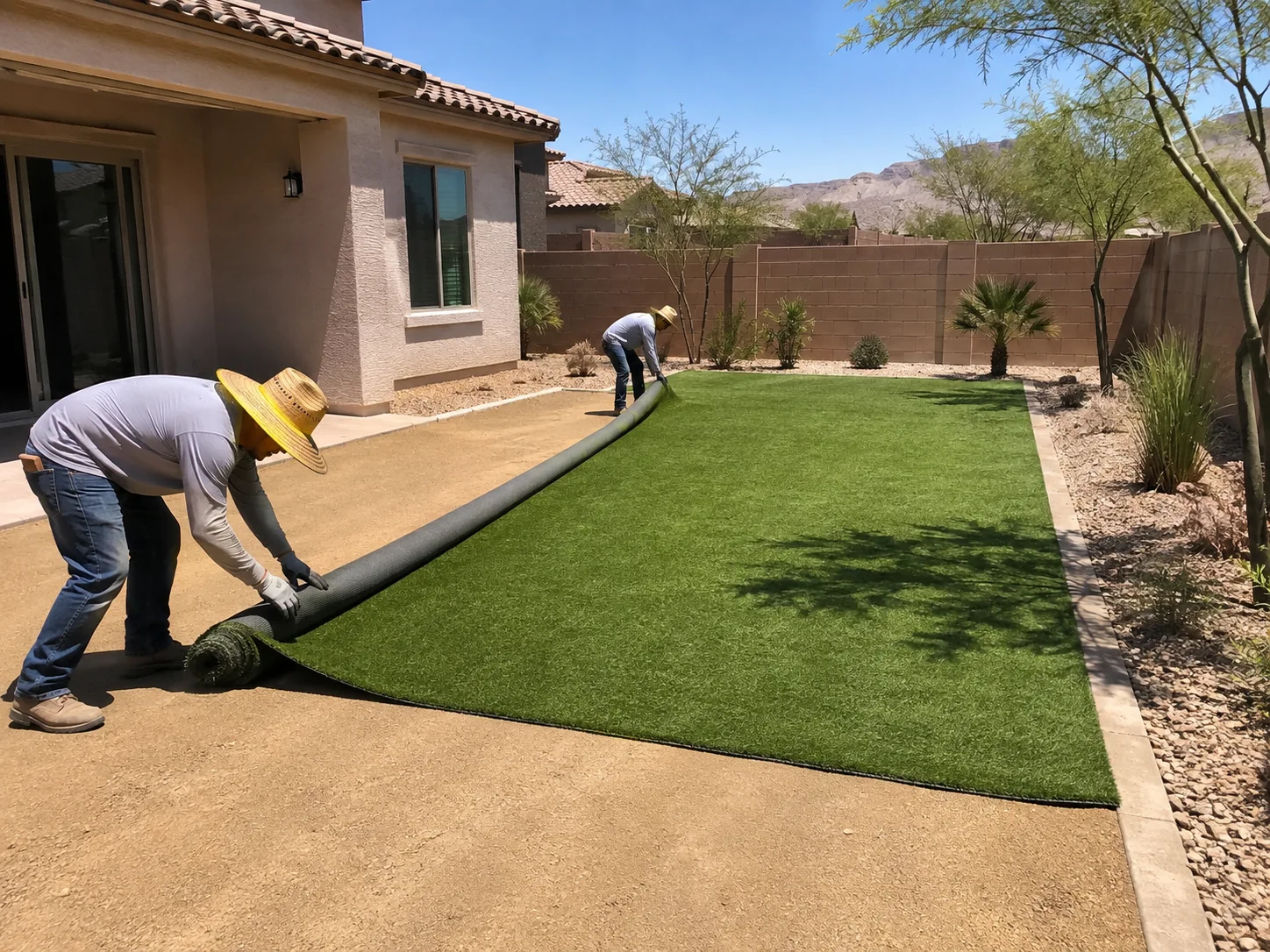
Caliche sits at wildly inconsistent depths. One Henderson yard has three feet of workable soil above it; the neighbour has four inches. Where it is shallow and thick, reaching proper base depth means breaking through hardpan rather than digging soil — different equipment, more hours, more spoil to haul.
This is the single largest reason two similar-looking yards get quoted thousands apart, and it is why we probe before quoting rather than pricing by square foot alone. An installer who quotes your yard without checking is guessing, and the guess gets corrected on installation day at your expense.
Henderson averages very little rainfall, and then a monsoon cell drops an inch in twenty minutes. That water has to go somewhere fast.
On permeable soil it soaks in. On caliche it does not — it sits. A base built on shallow hardpan without a designed outlet becomes a shallow basin under your turf. The turf looks fine; underneath, water pools, the base softens, and over seasons the surface settles unevenly.
We test depth at the estimate so the quote reflects the actual yard.
Where hardpan blocks proper base depth, it comes out. Building a shallow base on top of caliche because breaking it is inconvenient is the shortcut that produces failures.
Angular crushed stone with void space, graded to fall toward an outlet. The base stores a monsoon burst temporarily and moves it laterally rather than letting it pool.
Where the yard is enclosed by block wall on all sides — which in Henderson is most of them — water needs a route out. That may be a French drain to a low point, a dry well punched through the caliche layer, or a tie-in to existing site drainage.
Layers compacted individually give uniform density. A single deep layer compacts only at the surface.
Relevant if you are doing a rebate conversion. The 50 percent living plant coverage requirement means planting into ground that may have hardpan under it. Planting holes need to break through, or roots sit in an impermeable bowl and the plant drowns during the one week a year it rains hard. We account for this when we design conversions.
That third question matters most. An installer who has not priced caliche will find it and bill you for it.
Most estimates are scheduled within 48 hours.
Tell us the space and we’ll give you a firm, written price. No pressure, no obligation.